2 stories credited to SCOTUSblog
Latest story Apr 15, 2026 · on ChamberLight since Apr 2026
A story can appear as several articles (copies of the same piece), so counts of stories and of articles differ.
Scores for SCOTUSblog
Writing quality not enough rated stories yet: 1 of 10. How it is measured
Scores last checked Sep 25, 2026.
Stories ChamberLight collected, by month
Stories credited to SCOTUSblog, by publication date. ChamberLight collects articles that mention the officials it tracks, so this shows its own coverage of this source, not how much the source publishes.
- Stories from SCOTUSblog
- Shaded: ChamberLight collected no stories, or almost none, from any outlet (a gap in its collection, not in the outlet’s publishing)
Show as a table
| Month | Stories | All outlets |
|---|---|---|
| April 2026 | 2 | 4,010 |
| May 2026 | 0 | none collected |
| June 2026 | 0 | none collected |
| July 2026 | 0 | none collected |
| August 2026 | 0 | 1 (collection gap) |
| September 2026 | 0 | 598 |
Top topics
Share of this source’s stories tagged with each topic. A story can carry several topics, so the shares do not add up to 100%.
- Ethics/Corruption2
100% of 2 stories · 56% across all outlets
- Criminal Justice1
50% of 2 stories · 18% across all outlets
- Economy1
50% of 2 stories · 24% across all outlets
- Immigration1
50% of 2 stories · 12% across all outlets
- Voting Rights1
50% of 2 stories · 18% across all outlets
The thin mark on each bar is the topic’s share across all outlets.
Who they cover
Party of the officials these stories are mainly about, across all 3 officials named. A story counts once for each official it is mainly about, so the split is over 3 story–official pairs, from 2 stories.
- Republican67% · 2 pairs
- Party not recorded33% · 1 pair
Most covered
Stories mainly about each official, and their share of the source’s 2 stories.
Article tone
ChamberLight’s article analysis assigns each story a tone toward the official it covers. It describes the coverage of that official, not SCOTUSblog’s stance, and reader votes do not change it. 2 stories.
- Good Look
- 0 (0%)
- Mixed
- 2 (100%)
- Informational
- 0 (0%)
- Bad Look
- 0 (0%)
Challenges to these scores
No one has challenged a score on this page yet. Anyone can; editors publish every outcome here.
Articles served from scotusblog.com
3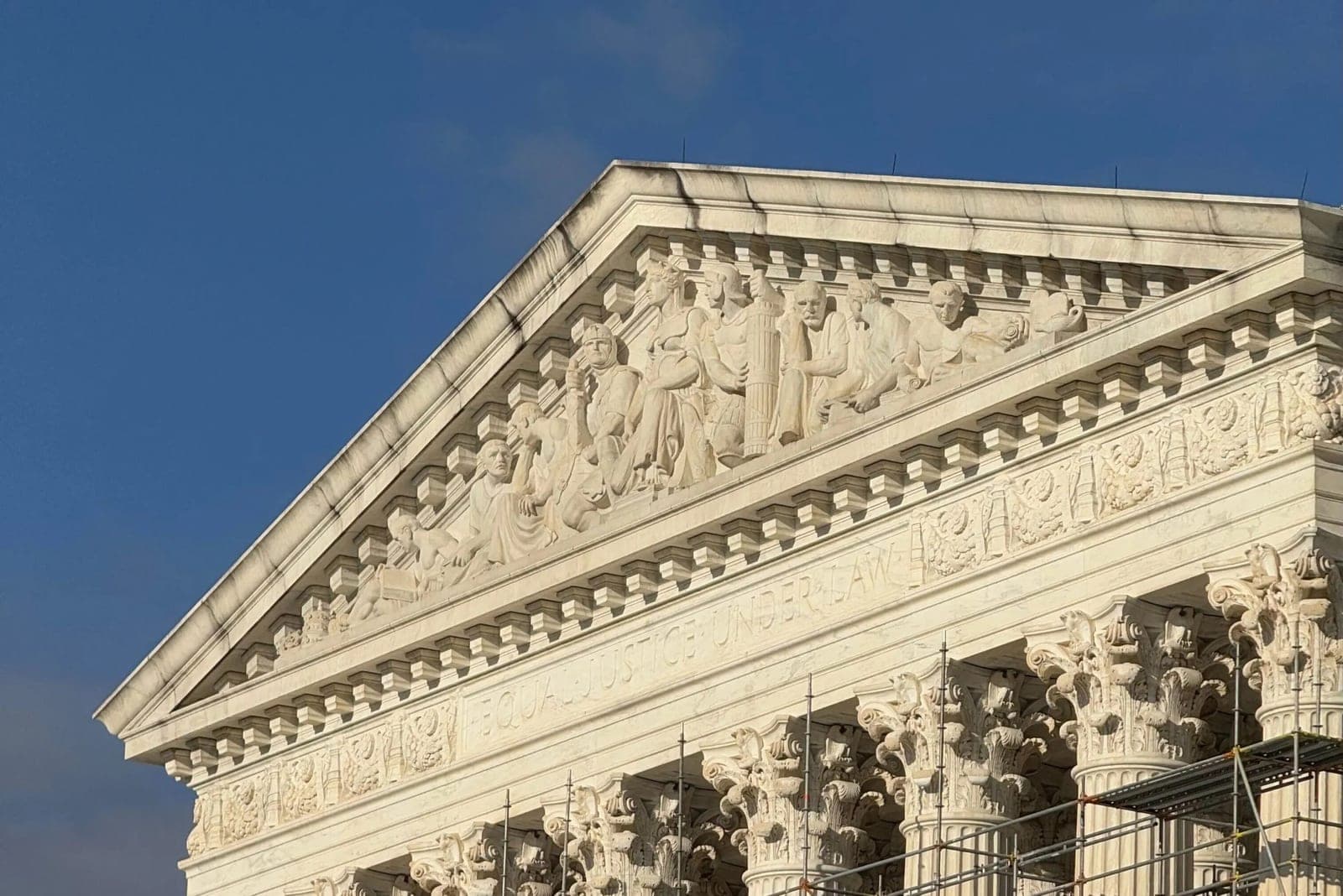
SCOTUStoday for Wednesday, April 15
First “The Late Show with Stephen Colbert,” now “The View.” Hosts Alyssa Farah Griffin and Sunny Hostin shared their SCOTUSblog fandom during Sarah Isgur’s appearance on the show on Tuesday. At the Court On Tuesday, the court indicated that it may announce opinions on Friday at 10 a.m. EDT. We will be live blogging that morning beginning at 9:30 a.m. Also on Friday, the justices will meet in a private conference to discuss cases and vote on petitions for review. Orders from that conference are expected on Monday at 9:30 a.m. EDT. Monday is the start of the court’s April argument session. Morning Reads Senate GOP ‘prepared’ to confirm Alito high court replacement before midterm elections David Sivak, The Washington Examiner Senate Majority Leader John Thune, a Republican from South Dakota, told The Washington Examiner on Tuesday that “Senate Republicans would move to confirm a replacement for Supreme Court Justice Samuel Alito before the midterm elections, should he choose to retire in the coming weeks.” “That’s a contingency, I think, around here you always have to be prepared for. And if that were to happen, yes, we would be prepared to confirm,” Thune said. Immigrants who care for seniors under threat in Trump court fight, nursing homes say Christopher Rowland, The Washington Post In an amicus, or “friend of the court,” brief filed on Monday, nursing home operators warned that “[r]evoking the right of Haitian immigrants to remain in the United States would deliver a blow to the workforce that cares for America’s seniors,” according to The Washington Post. “The filing did not detail how many Haitians work in the senior care industry. But the Migration Policy Institute estimated that in 2021, about 103,000 Haitian immigrants were health-care workers (the sixth-largest group of immigrant health care workers in the United States).” The Supreme Court will hear argument on the Trump administration’s effort to end Haitians’ and Syrians’ participation in the Temporary Protected Status program on Wednesday, April 29. Trump Chooses His Personal Lawyers for Federal Appeals Courts Jacqueline Thomsen, Bloomberg Law During his second term, President Donald Trump has “repeatedly turn[ed] to his personal legal teams to fill seats on the federal appeals courts,” according to Bloomberg Law. Earlier this year, he nominated “Missouri lawyer Justin Smith, who worked on an appeal of a judgment against Trump in a defamation case by the writer E. Jean Carroll,” to the U.S. Court of Appeals for the 8th Circuit, and Friday, “Trump tapped Sullivan & Cromwell partner Matthew Schwartz for a seat on the Second Circuit, after Schwartz worked on multiple New York civil and criminal cases for the president.” Bloomberg noted that “[i]t’s a new source of judges for Trump, who doesn’t appear to have appointed any of his private attorneys to the federal bench during his first term,” but also observed that “it’s not unusual for presidents to appoint people they know to be federal judges: Brett Kavanaugh worked as White House staff secretary before President George W. Bush nominated him to the DC Circuit.” 5 Points on the Effort to Block Trump’s Latest Tariffs Layla A. Jones, Talking Points Memo On Friday, the Trump administration appeared before the U.S. Court of International Trade to defend its effort to replace the tariffs struck down by the Supreme Court in February with “a new, sweeping 10% tariff on a broad swath of products and countries” imposed under Section 122 of the Trade Act of 1974. Talking Points Memo compiled five key points about the legal battle against these Section 122 tariffs, including the challengers’ claim that Section 122 is obsolete. “Counsel for states and small businesses are arguing that the U.S. is not on the same kind of currency system this statute was created to address, thus making it impossible not just for the president to use this statute today, but for the confluence of conditions necessary to trigger Section 122 tariff powers to exist at all.” When SCOTUS Did Lasting Damage to the Bill of Rights Damon Root, Reason In his Injustice System newsletter for Reason, Damon Root revisited an 1876 Supreme Court case called United States v. Cruikshank, explaining why he considers it to be one of the court’s “judicial travesties.” Cruikshank stemmed from the Colfax massacre, during which “an armed white mob linked to the local Democrats launched an attack on the courthouse in the town of Colfax, [Louisiana,] where hundreds of black supporters of the local Republicans, including members of a black militia, had gathered.” Around 100 Black people died, and several members of the white mob, including William Cruikshank, were charged with depriving “certain citizens of African descent” of their constitutional rights, including the right to assemble and bear arms. They defended themselves by arguing that the Bill of Rights didn’t apply to state governments or private individuals, and the Supreme Court sided with them. “Nowadays, it is established that the liberties in the Bill of Rights generally apply against both the federal government and the states. But at the time when Cruikshank was decided, a majority of the Supreme Court was adamantly opposed to that position,” Root wrote. On Site Case Preview Justices to hear argument on right to jury trial in FCC proceedings The Seventh Amendment guarantees a right to a jury trial in “suits at common law.” In 2024, the Supreme Court ruled in SEC v. Jarkesy that the Securities and Exchange Commission’s imposition of fines in its administrative proceedings as a penalty for securities fraud violated that guarantee. On Tuesday, the justices will consider whether that same reasoning applies to fines that the FCC imposes for violations of federal communications laws. Podcasts Advisory Opinions Sotomayor vs. Kavanaugh? Sarah Isgur and David French revisit Stephen Colbert’s favorite case, take a look at a rare biting word about Justice Brett Kavanaugh from Justice Sonia Sotomayor, and dive into a circuit court extravaganza. A Closer Look: “Neither Party” Amicus Briefs Chatrie v. United States, a case about whether the use of a “geofence” warrant violated the Fourth Amendment, will be argued on Monday, April 27. Consistent with several other cases this term, the issue has garnered a large number of amicus, or “friend of the court,” briefs – 31, in fact. But out of those 31, eight are “in support of neither party.” What does that mean, exactly? If you’re in support of, well, neither party, why even bother to file an (often labor-intensive) amicus brief? A “neither party” filer often has something to say to the court that doesn’t map onto a clean outcome for either side (e.g., about how to frame the question, what factual or technical context the parties have omitted, how broadly or narrowly to rule, etc.). This is probably best illustrated through some cases themselves. Moody v. NetChoice (from the 2023-24 term) produced 13 “neither party” briefs, including one from the Knight First Amendment Institute, which argued that “none of the parties in this case offers a compelling theory of how the First Amendment should apply to the regulation of social media.” Per the Institute, the states’ (there, Florida and Texas) arguments would, among other things, “give governments sweeping authority over the digital public sphere” – while the platforms’ arguments would “make it nearly impossible for governments to enact even carefully drawn laws that serve First Amendment values.” In other words, according to this amicus brief, both parties went too far. By contrast, in the same term’s United States v. Rahimi, which dealt with whether a federal statute that temporarily disarms anyone subject to a domestic-violence restraining order violates the Second Amendment, only one of the 60 amicus briefs was filed in support of neither party. That filing came from a historian and legal scholar, who wrote that the court should take a “macro approach” when it comes to deciding the constitutionality of certain firearm regulations. Instead, he wrote in a 43-page brief, the parties took a mistaken “micro approach” (i.e., focusing on specific history and tradition elements rather than larger historical trends) that risked “the courts resorting to historical conjecture and speculation in forming judgments.” Back in Chatrie, the eight “neither party” briefs share (at least) one thing in common: the contention that neither party’s proposed framework or solution is quite adequate for deciding the broader questions raised by geofence warrants. For instance, Microsoft Corporation argues that users “maintain a reasonable expectation of privacy in private information when using the cloud” and that “reverse warrants” must be “sufficiently particular and supported by probable cause that is individualized to each person searched” – which aligns partially with Okello Chatrie’s position, who challenges the geofence warrant as far too expansive. But Microsoft differs from Chatrie in that it does not take a position on whether the specific warrant used in his case “complied with the Fourth Amendment.” The Policing Project at NYU School of Law is perhaps the most explicit about its reasoning, writing that “[t]his case should be resolved narrowly so as not to embarrass the future.” As Policing Project founder Barry Friedman said when the brief was filed: “Given the technical complexities of these tools, the risks they present to our liberties, and their potential public safety benefits when used responsibly by police, the right fix for this is legislative.” In sum, such briefs advise the court: “when you make your decision, please do it this way.” SCOTUS Quote CHIEF JUSTICE ROBERTS: “And while – while you may think a hovercraft is unsightly, I mean, if you’re trying to get from point A to point B, it’s pretty beautiful.” — Sturgeon v. Frost (2018) The post SCOTUStoday for Wednesday, April 15 appeared first on SCOTUSblog.
SCOTUStoday for Wednesday, April 15
First “The Late Show with Stephen Colbert,” now “The View.” Hosts Alyssa Farah Griffin and Sunny Hostin shared their SCOTUSblog fandom during Sarah Isgur’s appearance on the show on Tuesday. At the Court On Tuesday, the court indicated that it may announce opinions on Friday at 10 a.m. EDT. We will be live blogging that morning beginning at 9:30 a.m. Also on Friday, the justices will meet in a private conference to discuss cases and vote on petitions for review. Orders from that conference are expected on Monday at 9:30 a.m. EDT. Monday is the start of the court’s April argument session. Morning Reads Senate GOP ‘prepared’ to confirm Alito high court replacement before midterm elections David Sivak, The Washington Examiner Senate Majority Leader John Thune, a Republican from South Dakota, told The Washington Examiner on Tuesday that “Senate Republicans would move to confirm a replacement for Supreme Court Justice Samuel Alito before the midterm elections, should he choose to retire in the coming weeks.” “That’s a contingency, I think, around here you always have to be prepared for. And if that were to happen, yes, we would be prepared to confirm,” Thune said. Immigrants who care for seniors under threat in Trump court fight, nursing homes say Christopher Rowland, The Washington Post In an amicus, or “friend of the court,” brief filed on Monday, nursing home operators warned that “[r]evoking the right of Haitian immigrants to remain in the United States would deliver a blow to the workforce that cares for America’s seniors,” according to The Washington Post. “The filing did not detail how many Haitians work in the senior care industry. But the Migration Policy Institute estimated that in 2021, about 103,000 Haitian immigrants were health-care workers (the sixth-largest group of immigrant health care workers in the United States).” The Supreme Court will hear argument on the Trump administration’s effort to end Haitians’ and Syrians’ participation in the Temporary Protected Status program on Wednesday, April 29. Trump Chooses His Personal Lawyers for Federal Appeals Courts Jacqueline Thomsen, Bloomberg Law During his second term, President Donald Trump has “repeatedly turn[ed] to his personal legal teams to fill seats on the federal appeals courts,” according to Bloomberg Law. Earlier this year, he nominated “Missouri lawyer Justin Smith, who worked on an appeal of a judgment against Trump in a defamation case by the writer E. Jean Carroll,” to the U.S. Court of Appeals for the 8th Circuit, and Friday, “Trump tapped Sullivan & Cromwell partner Matthew Schwartz for a seat on the Second Circuit, after Schwartz worked on multiple New York civil and criminal cases for the president.” Bloomberg noted that “[i]t’s a new source of judges for Trump, who doesn’t appear to have appointed any of his private attorneys to the federal bench during his first term,” but also observed that “it’s not unusual for presidents to appoint people they know to be federal judges: Brett Kavanaugh worked as White House staff secretary before President George W. Bush nominated him to the DC Circuit.” 5 Points on the Effort to Block Trump’s Latest Tariffs Layla A. Jones, Talking Points Memo On Friday, the Trump administration appeared before the U.S. Court of International Trade to defend its effort to replace the tariffs struck down by the Supreme Court in February with “a new, sweeping 10% tariff on a broad swath of products and countries” imposed under Section 122 of the Trade Act of 1974. Talking Points Memo compiled five key points about the legal battle against these Section 122 tariffs, including the challengers’ claim that Section 122 is obsolete. “Counsel for states and small businesses are arguing that the U.S. is not on the same kind of currency system this statute was created to address, thus making it impossible not just for the president to use this statute today, but for the confluence of conditions necessary to trigger Section 122 tariff powers to exist at all.” When SCOTUS Did Lasting Damage to the Bill of Rights Damon Root, Reason In his Injustice System newsletter for Reason, Damon Root revisited an 1876 Supreme Court case called United States v. Cruikshank, explaining why he considers it to be one of the court’s “judicial travesties.” Cruikshank stemmed from the Colfax massacre, during which “an armed white mob linked to the local Democrats launched an attack on the courthouse in the town of Colfax, [Louisiana,] where hundreds of black supporters of the local Republicans, including members of a black militia, had gathered.” Around 100 Black people died, and several members of the white mob, including William Cruikshank, were charged with depriving “certain citizens of African descent” of their constitutional rights, including the right to assemble and bear arms. They defended themselves by arguing that the Bill of Rights didn’t apply to state governments or private individuals, and the Supreme Court sided with them. “Nowadays, it is established that the liberties in the Bill of Rights generally apply against both the federal government and the states. But at the time when Cruikshank was decided, a majority of the Supreme Court was adamantly opposed to that position,” Root wrote. On Site Case Preview Justices to hear argument on right to jury trial in FCC proceedings The Seventh Amendment guarantees a right to a jury trial in “suits at common law.” In 2024, the Supreme Court ruled in SEC v. Jarkesy that the Securities and Exchange Commission’s imposition of fines in its administrative proceedings as a penalty for securities fraud violated that guarantee. On Tuesday, the justices will consider whether that same reasoning applies to fines that the FCC imposes for violations of federal communications laws. Podcasts Advisory Opinions Sotomayor vs. Kavanaugh? Sarah Isgur and David French revisit Stephen Colbert’s favorite case, take a look at a rare biting word about Justice Brett Kavanaugh from Justice Sonia Sotomayor, and dive into a circuit court extravaganza. A Closer Look: “Neither Party” Amicus Briefs Chatrie v. United States, a case about whether the use of a “geofence” warrant violated the Fourth Amendment, will be argued on Monday, April 27. Consistent with several other cases this term, the issue has garnered a large number of amicus, or “friend of the court,” briefs – 31, in fact. But out of those 31, eight are “in support of neither party.” What does that mean, exactly? If you’re in support of, well, neither party, why even bother to file an (often labor-intensive) amicus brief? A “neither party” filer often has something to say to the court that doesn’t map onto a clean outcome for either side (e.g., about how to frame the question, what factual or technical context the parties have omitted, how broadly or narrowly to rule, etc.). This is probably best illustrated through some cases themselves. Moody v. NetChoice (from the 2023-24 term) produced 13 “neither party” briefs, including one from the Knight First Amendment Institute, which argued that “none of the parties in this case offers a compelling theory of how the First Amendment should apply to the regulation of social media.” Per the Institute, the states’ (there, Florida and Texas) arguments would, among other things, “give governments sweeping authority over the digital public sphere” – while the platforms’ arguments would “make it nearly impossible for governments to enact even carefully drawn laws that serve First Amendment values.” In other words, according to this amicus brief, both parties went too far. By contrast, in the same term’s United States v. Rahimi, which dealt with whether a federal statute that temporarily disarms anyone subject to a domestic-violence restraining order violates the Second Amendment, only one of the 60 amicus briefs was filed in support of neither party. That filing came from a historian and legal scholar, who wrote that the court should take a “macro approach” when it comes to deciding the constitutionality of certain firearm regulations. Instead, he wrote in a 43-page brief, the parties took a mistaken “micro approach” (i.e., focusing on specific history and tradition elements rather than larger historical trends) that risked “the courts resorting to historical conjecture and speculation in forming judgments.” Back in Chatrie, the eight “neither party” briefs share (at least) one thing in common: the contention that neither party’s proposed framework or solution is quite adequate for deciding the broader questions raised by geofence warrants. For instance, Microsoft Corporation argues that users “maintain a reasonable expectation of privacy in private information when using the cloud” and that “reverse warrants” must be “sufficiently particular and supported by probable cause that is individualized to each person searched” – which aligns partially with Okello Chatrie’s position, who challenges the geofence warrant as far too expansive. But Microsoft differs from Chatrie in that it does not take a position on whether the specific warrant used in his case “complied with the Fourth Amendment.” The Policing Project at NYU School of Law is perhaps the most explicit about its reasoning, writing that “[t]his case should be resolved narrowly so as not to embarrass the future.” As Policing Project founder Barry Friedman said when the brief was filed: “Given the technical complexities of these tools, the risks they present to our liberties, and their potential public safety benefits when used responsibly by police, the right fix for this is legislative.” In sum, such briefs advise the court: “when you make your decision, please do it this way.” SCOTUS Quote CHIEF JUSTICE ROBERTS: “And while – while you may think a hovercraft is unsightly, I mean, if you’re trying to get from point A to point B, it’s pretty beautiful.” — Sturgeon v. Frost (2018) The post SCOTUStoday for Wednesday, April 15 appeared first on SCOTUSblog.

Supreme Court declines to block lower court ruling in election dispute on political speech
Updated on April 9 at 11:41 a.m. The Supreme Court on Thursday declined to block Ohio officials from removing Sam Ronan, who was running as a Republican for the state’s 15th congressional district, from Ohio’s Republican primary election ballot. Lawyers for Ohio Secretary of State Frank LaRose, as well as county election officials, had urged the court on Wednesday to let them go ahead with a ballot that does not Ronan. Ohio Solicitor General Mathura Sridharan, representing LaRose, told the justices that Ronan faced “an all-but-insurmountable obstacle” to obtaining relief, because he is seeking “an extraordinary, first-in-time injunction reinstating his candidacy in an ongoing election.” Ronan is an Air Force veteran who seeks to challenge incumbent U.S. Rep. Mike Carey, a Republican who represents the 15th District, which stretches out from the Columbus suburbs, in the Republican primary. President Donald Trump won the district by nine points in 2024. Ronan ran for the chair of the Democratic National Committee in 2017. During that race, LaRose said, Ronan “continued to advocate for his strategy of running Democrats as Republicans in deeply red districts.” Last month, Ronan was removed from the ballot when a voter protested his candidacy, alleging that Ronan was “not in fact a Republican.” The Franklin County Board of Elections divided two to two on the challenge; the dispute then went to LaRose, who broke the tie in favor of the protester and removing Ronan from the ballot. Ronan went to federal court, where he argued (among other things) that his removal from the ballot violates the First Amendment. But two federal courts declined to intervene. The U.S. Court of Appeals for the 6th Circuit agreed with U.S. District Judge Sarah Morrison that although Ronan could change political parties, state law – which requires him to attest (among other things) that if elected he would “support and abide by the principles enunciated by the Republican Party” – requires him to do so in good faith. Ronan had not shown, the court of appeals concluded, that such a requirement violates the First Amendment. That prompted Ronan to come to the Supreme Court on Monday. In a 23-page filing on the court’s interim docket, Ronan argued that “it is undisputed that” he was removed from the ballot “based solely on the content of his core political speech.” Unless the Supreme Court steps in, he said, he would be removed from the ballot by the time early voting begins on April 7, a date that passed before the Supreme Court announced its decision on Thursday. Both LaRose and the county election officials asked the justices to deny Ronan’s request. As an initial matter, LaRose emphasized, the 6th Circuit was correct that Ronan is unlikely to succeed on the merits of his claim. “The First Amendment,” he wrote, “does not restrict the State from promoting order, fairness, and integrity in their elections.” Instead, he contended, states have “wide latitude to regulate party primaries and other candidate-selection mechanics” to bring order to the election process. Moreover, the county election officials added, Ronan has other options if he is not included on the Republican primary ballot: he can always run as an independent candidate, for example. And the Supreme Court’s intervention now would “introduce uncertainty” into the election process – especially when “voters have already been informed that Ronan is not a candidate.” The post Supreme Court declines to block lower court ruling in election dispute on political speech appeared first on SCOTUSblog.