
Search

Search people, articles, bills, and more

Racket logo

Racket

racket.news

NewsletterProvenance not yet reviewedIndividual writer

2 stories credited to Racket (1 on racket.news, 1 reproduced by other sites)

Latest story Apr 7, 2026 · on ChamberLight since Apr 2026

Scores for Racket

Credibility

An individual writer or an online community, not a news organization, so the newsroom rating does not apply.

How this is measured

Political lean

An individual writer or an online community, not a news organization, so the newsroom rating does not apply.

How this is measured

Originality

Not enough stories yet: 1 of 10.

How this is measured

Scores last checked Sep 24, 2026.

Stories ChamberLight collected, by month

Stories credited to Racket, by publication date. ChamberLight collects articles that mention the officials it tracks, so this shows its own coverage of this source, not how much the source publishes.

  • Stories from Racket
  • Shaded: ChamberLight collected no stories, or almost none, from any outlet (a gap in its collection, not in the outlet’s publishing)
Show as a table
MonthStoriesAll outlets
March 20261521
April 202614,537
May 20260none collected
June 20260none collected
July 20260none collected
August 202601 (collection gap)
September 20260598

Top topics

Share of this source’s stories tagged with each topic. A story can carry several topics, so the shares do not add up to 100%.

  • Budget/Spending2

    100% of 2 stories · 33% across all outlets

  • Defense/Military1

    50% of 2 stories · 26% across all outlets

  • Ethics/Corruption1

    50% of 2 stories · 62% across all outlets

  • Foreign Policy1

    50% of 2 stories · 30% across all outlets

  • Voting Rights1

    50% of 2 stories · 20% across all outlets

The thin mark on each bar is the topic’s share across all outlets.

Who they cover

Party of the officials these stories are mainly about, across all 5 officials named. A story counts once for each official it is mainly about, so the split is over 5 story–official pairs, from 2 stories.

  • Republican60% · 3 pairs
  • Democrat40% · 2 pairs

Article tone

ChamberLight’s article analysis assigns each story a tone toward the official it covers. It describes the coverage of that official, not Racket’s stance, and reader votes do not change it. 2 stories.

Good Look
0 (0%)
Mixed
2 (100%)
Informational
0 (0%)
Bad Look
0 (0%)

Challenges to these scores

No one has challenged a score on this page yet. Anyone can; editors publish every outcome here.
Articles served from racket.news

1

Swamp Log — The SAVE Act, Civil Rights Filibuster, and ‘What The F*ck Is Cloture?’

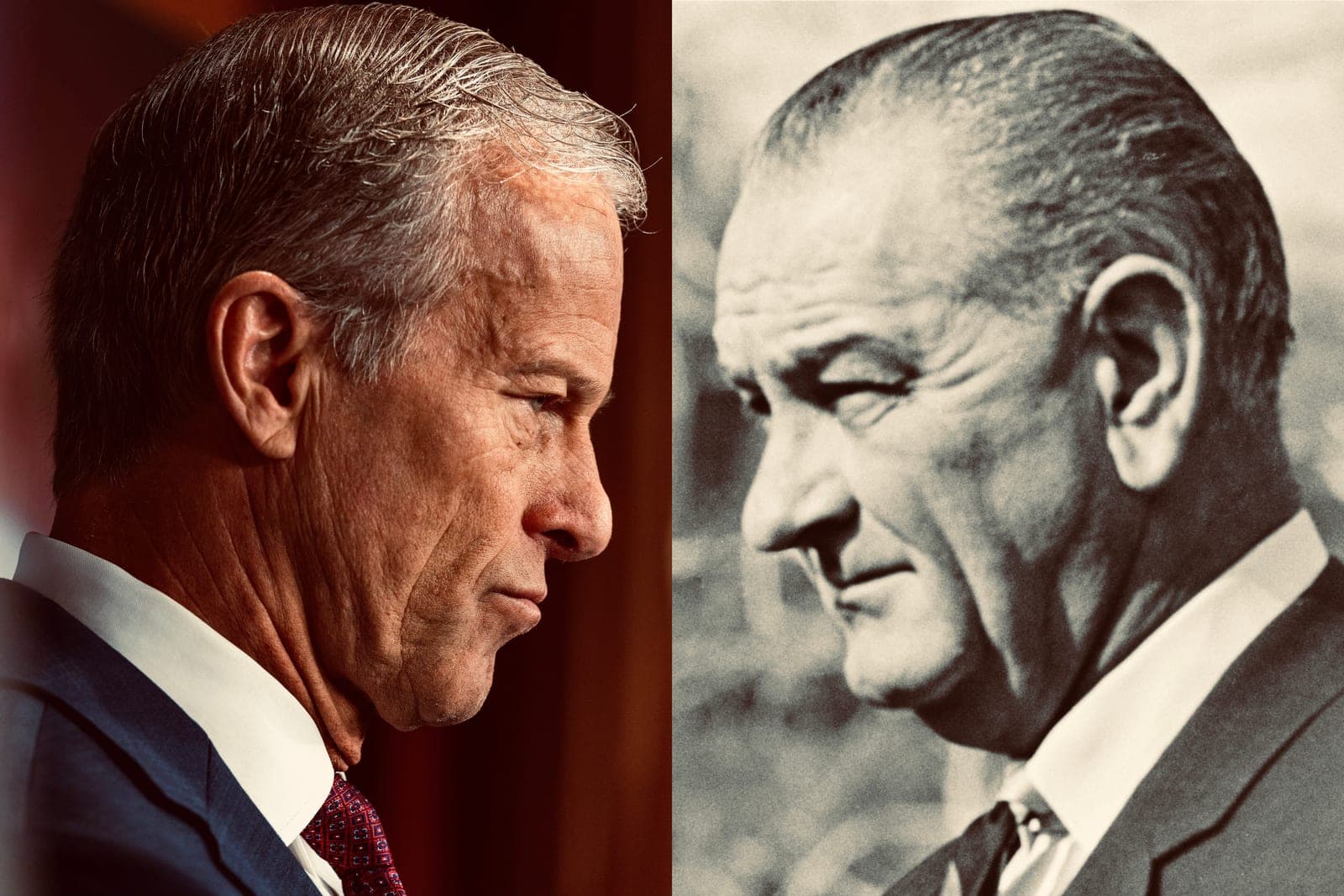
Senate Majority Leader John Thune and former President Lyndon B. Johnson (Photos by Tasos Katopodis/Getty Images, William Lovelace/Daily Express/Hulton Archive/Getty Images) Matt sent a text this week discussing ideas for Swamp Log, suggesting: “You could do a piece titled, ‘What the fuck is cloture?’” When I started covering the Senate last year, I was introduced to the ubiquitous term: CLOTURE. A frantic Google search early in my first day on the hill explained that cloture in the U.S. Senate ends debate, breaking a filibuster. OK… but how does it work? Is it in the Constitution? What are its implications? Why do some votes require the 60 votes needed to invoke cloture, and some don’t? Enter the SAVE America Act, President Donald Trump’s controversial voter ID legislation. Advocates of the bill began to call for the Republican majority to force a “talking filibuster” to pass the legislation — but what exactly did a “talking filibuster” entail? Interest in Senate rules became timely. The arcane procedures of the House and Senate are deliberately kept a mystery from constituents. Some members, like Nebraska Senator Deb Fischer, are former state legislators, and were raised in politics through interminable, little-attended statehouse exchanges. They understand the stage-managing of politics. Some bills emerge from committee with a wink, allowing members to jockey for public position for a bit, all the time knowing it will be killed procedurally. In other cases the outcome is less certain and Republicans and Democrats use rules as leverage for the horse-trading process that takes place when a bill is likely to pass, which seems more the case now. My idea with the Swamp Log going forward is to take readers on a guided tour of how Washington works, starting with the filibuster. For my own education, and hopefully yours, we’ll use this space to break down the Senate’s tradition of unlimited debate, and the SAVE America Act’s perilous relationship with the filibuster. WASHINGTON, DC - MARCH 17: Senate Majority Leader John Thune (R-SD), accompanied by Sen. Tom Cotton (R-AR) (L), and Sen. Shelley Moore Capito (R-WV) (R) speaks to reporters following a Republican policy luncheon at the U.S. Capitol Building on March 17, 2026 in Washington, DC. (Photo by Andrew Harnik/Getty Images) LUKEWARM DEBATE TO SAVE AMERICA The SAVE America Act is emblematic of Republican politics in 2026. President Donald Trump has described the legislation as his number one priority, and called loudly and often on Majority Leader John Thune to nuke the filibuster and change Senate rules to allow a simple majority to pass legislation. Read more

Apr 7, 202616 votes