1 story credited to HR Executive
Latest story Apr 22, 2026 · on ChamberLight since Apr 2026
A story can appear as several articles (copies of the same piece), so counts of stories and of articles differ.
Scores for HR Executive
Writing quality not enough rated stories yet: 1 of 10. How it is measured
Scores last checked Sep 25, 2026.
Stories ChamberLight collected, by month
Stories credited to HR Executive, by publication date. ChamberLight collects articles that mention the officials it tracks, so this shows its own coverage of this source, not how much the source publishes.
- Stories from HR Executive
- Shaded: ChamberLight collected no stories, or almost none, from any outlet (a gap in its collection, not in the outlet’s publishing)
Show as a table
| Month | Stories | All outlets |
|---|---|---|
| April 2026 | 1 | 265 |
| May 2026 | 0 | none collected |
| June 2026 | 0 | none collected |
| July 2026 | 0 | none collected |
| August 2026 | 0 | 1 (collection gap) |
| September 2026 | 0 | 598 |
Top topics
Share of this source’s stories tagged with each topic. A story can carry several topics, so the shares do not add up to 100%.
- Economy1
100% of 1 stories · 24% across all outlets
- Labor/Unions1
100% of 1 stories · 4% across all outlets
- Technology/Privacy1
100% of 1 stories · 9% across all outlets
The thin mark on each bar is the topic’s share across all outlets.
Who they cover
Party of the officials these stories are mainly about, across all 2 officials named. A story counts once for each official it is mainly about, so the split is over 2 story–official pairs, from 1 story.
- Democrat50% · 1 pair
- Republican50% · 1 pair
Most covered
Stories mainly about each official, and their share of the source’s 1 story.
Article tone
ChamberLight’s article analysis assigns each story a tone toward the official it covers. It describes the coverage of that official, not HR Executive’s stance, and reader votes do not change it. 1 story.
- Good Look
- 0 (0%)
- Mixed
- 1 (100%)
- Informational
- 0 (0%)
- Bad Look
- 0 (0%)
Challenges to these scores
No one has challenged a score on this page yet. Anyone can; editors publish every outcome here.
Articles served from hrexecutive.com
2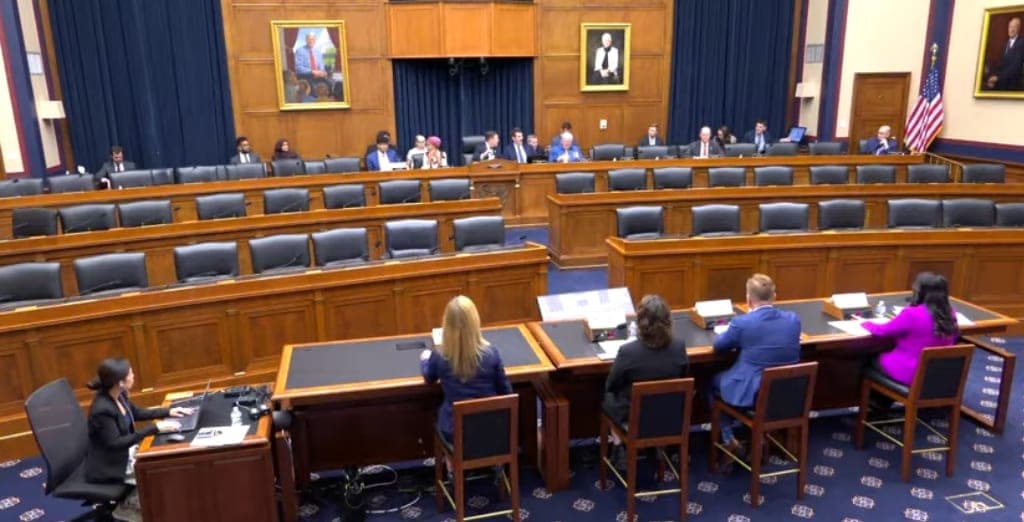
On Capitol Hill, a debate over who AI at work is really working for
Last week, Americans heard a Congressional hearing, the sixth in a series, about AI in the workplace. It was held by the House Education and Workforce Subcommittee hearing, chaired by Rep. Ryan Mackenzie (R-Pa.), on the topic of Building an AI-Ready America: Understanding AI’s Economic Impact on Workers and Employers. Employer-side witnesses pushed for a federal override of state laws, arguing that the New York City automated employment decision tool law is a cautionary example. A December 2025 audit by the New York State Comptroller found that the city lacks an effective system to enforce the law, which requires bias audits, public summaries and notices for automated employment decision tools. Worker advocates pushed back federal preemption of state regulations. Ranking Member Ilhan Omar called it “a blank check to big tech” and argued states need to remain free to protect workers while federal policy catches up. For background, several states, including California, Colorado, Illinois and Texas, have enacted legislation seeking to place parameters on AI-driven compensation and employment decisions, according to previous HR Executive reporting. AI in the workplace witnesses During the hearing, four witnesses brought their vantage points to the room. Chatrane Birbal, senior vice president of public policy and government relations for the CHRO Association, spoke on behalf of nearly 400 large U.S. employers. Matthew Paul Gizzo, a shareholder at Ogletree Deakins and co-chair of the firm’s Technology Practice Group, has a decade of wage and hour compliance experience and, more recently, AI governance experience. Sara Steffens, worker power director for Rebuild Progress, has 20 years of experience representing worker advocates. She has written that “public policy is critical to worker power.” Rachel Greszler, an economist with Advancing American Freedom, focused on data gaps and the policy risks of moving too fast or too slow. Together, the witnesses covered a range of what HR leaders are navigating right now. Read more: Congressional witnesses split on AI regulation, state laws stumble Easing administrative challenges Gizzo made a strong case for AI as a compliance tool, highlighting the needs of small and mid-size employers and the HR leaders they represent. “Wage and hour laws present significant compliance challenges for employers of all sizes,” Gizzo said, noting that well-intentioned employers stumble with the web of federal, state and local requirements. In FY2025, the DOL recovered more than $259 million in back wages. “Yet these recoveries are not indicative of employers acting in bad faith, because even well-intentioned employers routinely stumble navigating the dense web of federal, state and local requirements, where even minor oversights can result in significant exposure,” said Gizzo. He described specific use cases where technology can help prevent these errors. He named AI-assisted timekeeping that flags missed punches or calculation errors in real time, payroll platforms that automatically apply different overtime rules by jurisdiction and scheduling tools that help employers avoid predictive scheduling violations. “AI does not replace human judgment, it complements it,” he said. Gizzo asked Congressional policy to deliver a balanced federal framework that doesn’t suppress AI innovation in the compliance space, where “the benefits greatly outweigh the risks.” What CHROs are doing now Birbal described an emerging governance model at leading companies, where AI adoption led jointly by the chief people officer and the chief technology officer, with investment in training, communication and two-way employee feedback. Practical use cases she highlighted: Automating repetitive tasks such as summarizing customer service tickets, freeing workers for higher-judgment work Using badges, cameras and vehicle telematics for real-time safety monitoring in transportation and healthcare AI-assisted medical image analysis to help clinicians focus on complex cases Birbal’s regulatory recommendation was to skip the AI-specific statutes and instead clarify how existing laws apply, with a federal principle-based framework built around transparency, accountability and risk management. She also called for federal preemption of the growing patchwork of state laws, noting that conflicting definitions and audit mandates across New York, California and Colorado create real compliance headaches for multi-state employers. Fears of worker surveillance Steffens, worker power director for Rebuild Progress and a 20-year labor movement veteran, offered an AI-at-work counterweight. She pointed out that nearly 75% of U.S. employers currently use tracking tools and AI makes that surveillance faster, cheaper and harder for employees to detect. According to a study of 1,500 U.S.-based employers and 1,500 employees conducted by ExpressVPN and reviewed by HR Executive, 74% of companies now use online monitoring tools, including real-time screen tracking (59%) and web browsing logs (62%). Steffens’ specific concerns, relevant to HR leaders setting monitoring policy, included: corporations that routinely scan emails and web activity; Steffens expressed concern that employers are looking for union-organizing terms AI management tools that dictate task order are producing measurable increases in worker stress, burnout and injury “bossware” that takes screenshots of remote workers’ desktops and sends summaries to managers a lack of federal law currently requires employers to notify workers about AI monitoring “Without regulation, AI allows employers and data brokers to accumulate, analyze and sell workers’ highly specific data in ways that can never be erased,” Steffens said. She called for federal disclosure requirements and clear limits on what employers can collect, store and share, including biometrics, location data and communications. A gap between data and policy Economist Greszler, a senior research fellow from Advancing American Freedom, said it’s challenging to plan ahead because most organizations don’t have the data to know where AI is replacing tasks, which jobs are most exposed or what skills will be in demand. She offered two recommendations: Direct the Census Bureau to expand its Business Trends and Outlook Survey to collect detailed AI deployment data by function and its effects on employment and skills. Direct the Bureau of Labor Statistics to build a task-based classification system from its existing Occupational Requirements Survey, tracking how AI affects tasks. “AI more often replaces tasks as opposed to entire jobs,” Greszler said, which has direct implications for how HR leaders approach workforce planning, reskilling investment and job architecture. She also flagged a related data problem. The BLS contingent worker survey undercounts independent contractors, reporting roughly 12 million in 2023 against other independent estimates of up to 72 million. The post On Capitol Hill, a debate over who AI at work is really working for appeared first on HR Executive.
On Capitol Hill, a debate over who AI at work is really working for
Last week, Americans heard a Congressional hearing, the sixth in a series, about AI in the workplace. It was held by the House Education and Workforce Subcommittee hearing, chaired by Rep. Ryan Mackenzie (R-Pa.), on the topic of Building an AI-Ready America: Understanding AI’s Economic Impact on Workers and Employers. Employer-side witnesses pushed for a federal override of state laws, arguing that the New York City automated employment decision tool law is a cautionary example. A December 2025 audit by the New York State Comptroller found that the city lacks an effective system to enforce the law, which requires bias audits, public summaries and notices for automated employment decision tools. Worker advocates pushed back federal preemption of state regulations. Ranking Member Ilhan Omar called it “a blank check to big tech” and argued states need to remain free to protect workers while federal policy catches up. For background, several states, including California, Colorado, Illinois and Texas, have enacted legislation seeking to place parameters on AI-driven compensation and employment decisions, according to previous HR Executive reporting. AI in the workplace witnesses During the hearing, four witnesses brought their vantage points to the room. Chatrane Birbal, senior vice president of public policy and government relations for the CHRO Association, spoke on behalf of nearly 400 large U.S. employers. Matthew Paul Gizzo, a shareholder at Ogletree Deakins and co-chair of the firm’s Technology Practice Group, has a decade of wage and hour compliance experience and, more recently, AI governance experience. Sara Steffens, worker power director for Rebuild Progress, has 20 years of experience representing worker advocates. She has written that “public policy is critical to worker power.” Rachel Greszler, an economist with Advancing American Freedom, focused on data gaps and the policy risks of moving too fast or too slow. Together, the witnesses covered a range of what HR leaders are navigating right now. Read more: Congressional witnesses split on AI regulation, state laws stumble Easing administrative challenges Gizzo made a strong case for AI as a compliance tool, highlighting the needs of small and mid-size employers and the HR leaders they represent. “Wage and hour laws present significant compliance challenges for employers of all sizes,” Gizzo said, noting that well-intentioned employers stumble with the web of federal, state and local requirements. In FY2025, the DOL recovered more than $259 million in back wages. “Yet these recoveries are not indicative of employers acting in bad faith, because even well-intentioned employers routinely stumble navigating the dense web of federal, state and local requirements, where even minor oversights can result in significant exposure,” said Gizzo. He described specific use cases where technology can help prevent these errors. He named AI-assisted timekeeping that flags missed punches or calculation errors in real time, payroll platforms that automatically apply different overtime rules by jurisdiction and scheduling tools that help employers avoid predictive scheduling violations. “AI does not replace human judgment, it complements it,” he said. Gizzo asked Congressional policy to deliver a balanced federal framework that doesn’t suppress AI innovation in the compliance space, where “the benefits greatly outweigh the risks.” What CHROs are doing now Birbal described an emerging governance model at leading companies, where AI adoption led jointly by the chief people officer and the chief technology officer, with investment in training, communication and two-way employee feedback. Practical use cases she highlighted: Automating repetitive tasks such as summarizing customer service tickets, freeing workers for higher-judgment work Using badges, cameras and vehicle telematics for real-time safety monitoring in transportation and healthcare AI-assisted medical image analysis to help clinicians focus on complex cases Birbal’s regulatory recommendation was to skip the AI-specific statutes and instead clarify how existing laws apply, with a federal principle-based framework built around transparency, accountability and risk management. She also called for federal preemption of the growing patchwork of state laws, noting that conflicting definitions and audit mandates across New York, California and Colorado create real compliance headaches for multi-state employers. Fears of worker surveillance Steffens, worker power director for Rebuild Progress and a 20-year labor movement veteran, offered an AI-at-work counterweight. She pointed out that nearly 75% of U.S. employers currently use tracking tools and AI makes that surveillance faster, cheaper and harder for employees to detect. According to a study of 1,500 U.S.-based employers and 1,500 employees conducted by ExpressVPN and reviewed by HR Executive, 74% of companies now use online monitoring tools, including real-time screen tracking (59%) and web browsing logs (62%). Steffens’ specific concerns, relevant to HR leaders setting monitoring policy, included: corporations that routinely scan emails and web activity; Steffens expressed concern that employers are looking for union-organizing terms AI management tools that dictate task order are producing measurable increases in worker stress, burnout and injury “bossware” that takes screenshots of remote workers’ desktops and sends summaries to managers a lack of federal law currently requires employers to notify workers about AI monitoring “Without regulation, AI allows employers and data brokers to accumulate, analyze and sell workers’ highly specific data in ways that can never be erased,” Steffens said. She called for federal disclosure requirements and clear limits on what employers can collect, store and share, including biometrics, location data and communications. A gap between data and policy Economist Greszler, a senior research fellow from Advancing American Freedom, said it’s challenging to plan ahead because most organizations don’t have the data to know where AI is replacing tasks, which jobs are most exposed or what skills will be in demand. She offered two recommendations: Direct the Census Bureau to expand its Business Trends and Outlook Survey to collect detailed AI deployment data by function and its effects on employment and skills. Direct the Bureau of Labor Statistics to build a task-based classification system from its existing Occupational Requirements Survey, tracking how AI affects tasks. “AI more often replaces tasks as opposed to entire jobs,” Greszler said, which has direct implications for how HR leaders approach workforce planning, reskilling investment and job architecture. She also flagged a related data problem. The BLS contingent worker survey undercounts independent contractors, reporting roughly 12 million in 2023 against other independent estimates of up to 72 million. The post On Capitol Hill, a debate over who AI at work is really working for appeared first on HR Executive.