4 stories credited to Argus Leader
Latest story Apr 15, 2026 · on ChamberLight since Apr 2026
A story can appear as several articles (copies of the same piece), so counts of stories and of articles differ.
Scores for Argus Leader
Writing quality not enough rated stories yet: 3 of 10. How it is measured
Scores last checked Sep 25, 2026.
Stories ChamberLight collected, by month
Stories credited to Argus Leader, by publication date. ChamberLight collects articles that mention the officials it tracks, so this shows its own coverage of this source, not how much the source publishes.
- Stories from Argus Leader
- Shaded: ChamberLight collected no stories, or almost none, from any outlet (a gap in its collection, not in the outlet’s publishing)
Show as a table
| Month | Stories | All outlets |
|---|---|---|
| April 2026 | 4 | 4,233 |
| May 2026 | 0 | none collected |
| June 2026 | 0 | none collected |
| July 2026 | 0 | none collected |
| August 2026 | 0 | 1 (collection gap) |
| September 2026 | 0 | 598 |
Top topics
Share of this source’s stories tagged with each topic. A story can carry several topics, so the shares do not add up to 100%.
- Economy2
50% of 4 stories · 24% across all outlets
- Ethics/Corruption2
50% of 4 stories · 56% across all outlets
- Agriculture1
25% of 4 stories · 2% across all outlets
- Budget/Spending1
25% of 4 stories · 30% across all outlets
- Education1
25% of 4 stories · 2% across all outlets
- Foreign Policy1
25% of 4 stories · 28% across all outlets
- Healthcare1
25% of 4 stories · 7% across all outlets
- Immigration1
25% of 4 stories · 12% across all outlets
The thin mark on each bar is the topic’s share across all outlets.
Who they cover
Party of the officials these stories are mainly about, across all 4 officials named. A story counts once for each official it is mainly about, so the split is over 6 story–official pairs, from 4 stories.
- Republican83% · 5 pairs
- Party not recorded17% · 1 pair
Most covered
Stories mainly about each official, and their share of the source’s 4 stories.
Article tone
ChamberLight’s article analysis assigns each story a tone toward the official it covers. It describes the coverage of that official, not Argus Leader’s stance, and reader votes do not change it. 4 stories.
- Good Look
- 2 (50%)
- Mixed
- 1 (25%)
- Informational
- 0 (0%)
- Bad Look
- 1 (25%)
Challenges to these scores
No one has challenged a score on this page yet. Anyone can; editors publish every outcome here.
Articles served from argusleader.com
6
$4 million for gunsmithing program is latest economic development grant from governor amid campaign
RAPID CITY — South Dakota’s governor, who’s in the midst of an election campaign, awarded another grant Tuesday from an economic development fund he controls. Republican Gov. Larry Rhoden announced a $4 million Future Fund award for Western Dakota Technical College in Rapid City. The college will use the money to move a gunsmithing school from Colorado and incorporate it into Western Dakota’s offerings for students. Rhoden, who attended Western Dakota decades ago but didn’t graduate, made the announcement at the college. “It’s fitting to me that South Dakota would be home for a school like this,” Rhoden said. “South Dakota is the most Second Amendment-friendly state in the nation.” Last week, Rhoden granted $6 million from the Future Fund to establish a South Dakota Defense Institute in Rapid City that will help companies in the state earn federal military contracts. That grant brought the unobligated balance of the Future Fund down to $13 million, a spokesperson for the Governor’s Office of Economic Development said at the time. A similar spurt of Future Fund grants from Rhoden last year sparked criticism from the three Republicans who are running for his job. Aberdeen businessman Toby Doeden called the grants an “attempt to buy votes,” state House Speaker Jon Hansen said the Future Fund was “funding the governor’s political future,” and U.S. Rep. Dusty Johnson said although Future Fund grants are an important economic development tool, “they aren’t meant to help someone’s campaign.” Meanwhile, Johnson has pledged that if he’s elected, he’ll use $2 million from the Future Fund to create a new local business startup initiative. Upon being reminded of that criticism Tuesday by South Dakota Searchlight, Rhoden called it “ridiculous” and said he’s awarding Future Fund grants to projects and ideas that will improve the state’s economy and workforce. “I am doing my job,” Rhoden said. “If you look at the opportunities that I have as a governor, as far as an appropriate use for Future Funds, this is picture perfect.” The state gets money for the Future Fund by charging a fee to employers. They pay the fee when they submit payroll taxes that support unemployment benefits. The late Republican Gov. George Mickelson convinced lawmakers to create the fund in 1987. They placed it under the governor’s exclusive control to enable quick responses to economic opportunities. State law says only that the fund “must be used for purposes related to research and economic development for the state,” but that’s about to change. Lawmakers approved new restrictions earlier this year, in response to past uses of the fund by Rhoden’s predecessor, former Gov. Kristi Noem. Rhoden was elevated from lieutenant governor after Noem resigned in January 2025 to become secretary of the federal Department of Homeland Security. Noem’s controversial uses of the Future Fund included a fireworks show at Mount Rushmore, the construction of a state-owned shooting range near Rapid City that legislators refused to fund, a rodeo in Sioux Falls where Noem carried the American flag into the arena on horseback, and a workforce recruitment advertising campaign that featured Noem as the star. Rhoden signed the legislative Future Fund reforms into law last month, but they won’t take effect until July 1 — after the June 2 primary election pitting Rhoden against three opponents for the Republican nomination. The reforms add legal definitions for acceptable uses of the fund, mandate more reporting to legislators about awards, specify the information required of applicants, direct the Governor’s Office of Economic Development to formulate rules for the fund’s use, and require the office to make recommendations to the governor about potential awards. The latest grant from Rhoden will help move the equipment, faculty and curriculum of the Colorado School of Trades, which operates solely as a gunsmithing school, to Western Dakota Tech. The president of the Colorado school, Ryan Lishner, said Tuesday that gun policies in Colorado “are starting to impede what firearms dealers and firearms manufacturers can do, and that’s getting to where it’s impacting our educational process.” He views South Dakota as willing to support the gunsmithing program “at a much higher level than Colorado was going to do.” The Colorado school can accommodate up to 20 faculty members and 140 students. After completing the 14-month program, students go on to professions ranging from self-employed gunsmiths to employees of major firearms manufacturers. “Western Dakota Tech is going to have the ability to grow that program to a much higher level,” Lishner said.

GOP governor debate: Key takeaways and voter reaction
The four candidates vying for the Republican nomination for South Dakota governor met for a second time Monday in a relatively well-tempered debate in Sioux Falls. The debate, co-moderated by South Dakota Public Broadcasting and South Dakota News Watch, saw little in terms of major clashes, with the candidates instead mostly focusing on staking out their policy positions and seeking to differentiate themselves in a crowded field. Gov. Larry Rhoden, who replaced former Gov. Kristi Noem in January 2025 after her appointment as secretary for Homeland Security, argued recent legislative accomplishments showed he should be given his own mandate to keep his job while U.S. House Rep. Dusty Johnson, state House Speaker Jon Hansen and Aberdeen businessman Toby Doeden offered their own visions for running the Mount Rushmore state. If no candidate receives at least 35% of the vote on the June 2 ballot, a runoff between the top two finishers will take place July 28. The winner of the contest will meet Democrat Dan Ahlers in the Nov. 3 general election. Here are some key takeaways from the debate: Johnson announced a plan to appoint a state surgeon general that would, among other things, assist in the managing of the state's Medicaid program in an effort to combat rising maternal and infant mortality rates. "We don't do a very good job of managing the Medicaid program today," he said. "We're going to get our arms around this." Hansen pledged to break up the South Dakota Department of Agriculture and Natural Resources. "I believe the South Dakota Department of Agriculture deserves its own department away from the people in the Department of Natural Resources," Hansen said. The two departments merged as a result of an executive order Noem issued in 2021. Doeden reiterated his plan to phase out property taxes completely, saying he will fill the budget hole by implementing policies that boost economic development, bringing in "external revenue sources" and cutting discretionary spending. He didn't specify the sources of revenue. "We don't need new taxes, we don't need higher taxes, we need more tax revenue," Doeden said. Similar to the first debate, Johnson and Rhoden clashed over the recently enacted property tax bills, which Johnson said has led to the largest sales tax increase in state history. Rhoden pointed out that one of the bills, which takes the planned 0.3% increase in the state sales tax next year to create a property tax relief fund for homeowners, was similar to Johnson's own proposal. "This rhetoric about sales tax. That's baloney," Rhoden said. "Congressman Johnson was going to use the exact same dollars for his property tax plan." On education, Hansen reiterated his support for creating publicly funded education grants for students regardless if they go to public school, private school or are home schooled. "I want to put parents in the driver's seat. I think parents know best," Hansen said. Each candidate sought to solidify their anti-abortion credentials when asked about their thoughts on whether the pro-life movement had achieved its objectives in South Dakota. Hansen cited his efforts in defeating Amendment G, a 2024 proposal to establish the right to an abortion in South Dakota. Rhoden touted recent legislation that makes it a felony to advertise, distribute or sell abortion pills. Doeden said raising living standards would help deter abortions, while Johnson said greater investments in K-12 education would also be a deterrent. Two political observers who talked to News Watch said that while the candidates appeared to only have minor policy differences, one candidate did outperform the rest on the night. "In terms of a winner, in a political debate it is usually the candidate that exceeds expectations," said Emily Wanless of Augustana University in Sioux Falls. "Rep. Jon Hansen met and exceeded my expectations." Hansen exuded a stronger leadership presence, while Rhoden appeared the weakest of the candidates on the debate stage, said Wanless, an associate professor of government and international affairs. "A lot of his answers lacked specific substance," Wanless said of Rhoden. "As someone trying to distinguish themselves as an incumbent governor, Rhoden is really struggling to separate himself from former Gov. Noem." Robert Burns of South Dakota State University echoed Wanless' sentiments that Hansen came out the biggest beneficiary of the debate while Rhoden struggled. "If you just paid attention to the optics of the debate, I really think Jon Hansen stood out," added Robert Burns of South Dakota State University. "On the other end, I think Gov. Rhoden stumbled more." The debate made it clear which wing of the Republican party each candidate represents, with Rhoden leaning on his role as the incumbent, Doeden cementing his status as the outsider, Hansen leading the Christian conservative faction and Johnson solidifying his position as the moderate voice, said Burns, distinguished professor emeritus of political science. Wanless said Johnson might need to tread carefully as he takes positions that appeal to a large swathe of the electorate but might not be to the core of GOP voters he needs to make it past the primary. "We have to remember who the target audience is for this debate: the Republican primary voter," she said. "It will be interesting to see how the property tax discussion goes because I think for Rep. Johnson to claim this affects more South Dakotans when you raise the sales tax, you're speaking to a demographic of voters that aren't going to be able to participate in the Republican primary." South Dakota's Republican Party operates a closed primary system, meaning only registered party members can vote in the June 2 primary. While she believes Hansen stood out in the debate, Wanless noted the emerging "insider vs. outsider" dynamic taking place in the gubernatorial race could potentially favor Johnson and Rhoden. "I think Doeden is a true outsider. He doesn't have that political experience to date, but Rep. Johnson is also an outsider because he's outside of state politics so he gets to play the outsider card but still have that name recognition," Wanless said. "On the insider front, I think Hansen is ultimately going to struggle because both he and Rhoden are seen as the insider candidates and the status quo in South Dakota politics, but Rhoden has the name recognition that Hansen does not." South Dakota News Watch also spoke to a couple of Republicans to get their thoughts on the debate. Heather DeVries is 42 years old, from Madison and describes herself as "active in both local and state politics." She said that she was encouraged, and in some cases, pleasantly surprised by candidates' responses to whether continuing pro-life legislation would be a priority. DeVries said she hopes that the candidates can commit to specific plans that the entire party can agree on, without "infighting." DeVries also said she hopes that the candidates consider working with non-governmental entities to support programming for maternal and infant health across the state. She called the debate "heated yet informative" and said that "while many claim to be pro-life on abortion, significant work still remains." "It takes a village to heal society, and that healing cannot begin until every life is cherished and protected under the law," DeVries said. "I hope the future governor will take all of that into consideration." Judd Schomp is a 49-year-old rancher from Martin. He is the chair of the Bennett County GOP and has served on the Bennett County Commission. Schomp told News Watch that he is concerned about whether the candidates are truly listening to voters’ concerns about divides within the party, which are worse than ever. In rural Bennett County and other areas across the state, some of the values they hold are starkly different to those of the candidates, and that they often feel “left behind” by the Republican Party, he said. Schomp said that he was not satisfied with any of the candidates’ responses to a question about how they will unify the Republican Party. He said he had issues with the candidates’ focus on attempting to create unity in the state Legislature and federal government rather than with South Dakotan voters. “Us voters remain small, divided and unheard,” Schomp said. “What I did not hear (during the debate) was, ‘South Dakota is the greatest state in the nation, and we’ve achieved that status because of the people here in South Dakota.’” South Dakota News Watch is an independent nonprofit. Read, donate and subscribe for free at sdnewswatch.org. Contact politics and statehouse reporter Alexander Rifaat: 605-736-4396/alexander.rifaat@sdnewswatch.org. Contact reporter/Report for America corps member Molly Wetsch: 605-531-7382/molly.wetsch@sdnewswatch.org.
GOP governor debate: Key takeaways and voter reaction
The four candidates vying for the Republican nomination for South Dakota governor met for a second time Monday in a relatively well-tempered debate in Sioux Falls. The debate, co-moderated by South Dakota Public Broadcasting and South Dakota News Watch, saw little in terms of major clashes, with the candidates instead mostly focusing on staking out their policy positions and seeking to differentiate themselves in a crowded field. Gov. Larry Rhoden, who replaced former Gov. Kristi Noem in January 2025 after her appointment as secretary for Homeland Security, argued recent legislative accomplishments showed he should be given his own mandate to keep his job while U.S. House Rep. Dusty Johnson, state House Speaker Jon Hansen and Aberdeen businessman Toby Doeden offered their own visions for running the Mount Rushmore state. If no candidate receives at least 35% of the vote on the June 2 ballot, a runoff between the top two finishers will take place July 28. The winner of the contest will meet Democrat Dan Ahlers in the Nov. 3 general election. Here are some key takeaways from the debate: Johnson announced a plan to appoint a state surgeon general that would, among other things, assist in the managing of the state's Medicaid program in an effort to combat rising maternal and infant mortality rates. "We don't do a very good job of managing the Medicaid program today," he said. "We're going to get our arms around this." Hansen pledged to break up the South Dakota Department of Agriculture and Natural Resources. "I believe the South Dakota Department of Agriculture deserves its own department away from the people in the Department of Natural Resources," Hansen said. The two departments merged as a result of an executive order Noem issued in 2021. Doeden reiterated his plan to phase out property taxes completely, saying he will fill the budget hole by implementing policies that boost economic development, bringing in "external revenue sources" and cutting discretionary spending. He didn't specify the sources of revenue. "We don't need new taxes, we don't need higher taxes, we need more tax revenue," Doeden said. Similar to the first debate, Johnson and Rhoden clashed over the recently enacted property tax bills, which Johnson said has led to the largest sales tax increase in state history. Rhoden pointed out that one of the bills, which takes the planned 0.3% increase in the state sales tax next year to create a property tax relief fund for homeowners, was similar to Johnson's own proposal. "This rhetoric about sales tax. That's baloney," Rhoden said. "Congressman Johnson was going to use the exact same dollars for his property tax plan." On education, Hansen reiterated his support for creating publicly funded education grants for students regardless if they go to public school, private school or are home schooled. "I want to put parents in the driver's seat. I think parents know best," Hansen said. Each candidate sought to solidify their anti-abortion credentials when asked about their thoughts on whether the pro-life movement had achieved its objectives in South Dakota. Hansen cited his efforts in defeating Amendment G, a 2024 proposal to establish the right to an abortion in South Dakota. Rhoden touted recent legislation that makes it a felony to advertise, distribute or sell abortion pills. Doeden said raising living standards would help deter abortions, while Johnson said greater investments in K-12 education would also be a deterrent. Two political observers who talked to News Watch said that while the candidates appeared to only have minor policy differences, one candidate did outperform the rest on the night. "In terms of a winner, in a political debate it is usually the candidate that exceeds expectations," said Emily Wanless of Augustana University in Sioux Falls. "Rep. Jon Hansen met and exceeded my expectations." Hansen exuded a stronger leadership presence, while Rhoden appeared the weakest of the candidates on the debate stage, said Wanless, an associate professor of government and international affairs. "A lot of his answers lacked specific substance," Wanless said of Rhoden. "As someone trying to distinguish themselves as an incumbent governor, Rhoden is really struggling to separate himself from former Gov. Noem." Robert Burns of South Dakota State University echoed Wanless' sentiments that Hansen came out the biggest beneficiary of the debate while Rhoden struggled. "If you just paid attention to the optics of the debate, I really think Jon Hansen stood out," added Robert Burns of South Dakota State University. "On the other end, I think Gov. Rhoden stumbled more." The debate made it clear which wing of the Republican party each candidate represents, with Rhoden leaning on his role as the incumbent, Doeden cementing his status as the outsider, Hansen leading the Christian conservative faction and Johnson solidifying his position as the moderate voice, said Burns, distinguished professor emeritus of political science. Wanless said Johnson might need to tread carefully as he takes positions that appeal to a large swathe of the electorate but might not be to the core of GOP voters he needs to make it past the primary. "We have to remember who the target audience is for this debate: the Republican primary voter," she said. "It will be interesting to see how the property tax discussion goes because I think for Rep. Johnson to claim this affects more South Dakotans when you raise the sales tax, you're speaking to a demographic of voters that aren't going to be able to participate in the Republican primary." South Dakota's Republican Party operates a closed primary system, meaning only registered party members can vote in the June 2 primary. While she believes Hansen stood out in the debate, Wanless noted the emerging "insider vs. outsider" dynamic taking place in the gubernatorial race could potentially favor Johnson and Rhoden. "I think Doeden is a true outsider. He doesn't have that political experience to date, but Rep. Johnson is also an outsider because he's outside of state politics so he gets to play the outsider card but still have that name recognition," Wanless said. "On the insider front, I think Hansen is ultimately going to struggle because both he and Rhoden are seen as the insider candidates and the status quo in South Dakota politics, but Rhoden has the name recognition that Hansen does not." South Dakota News Watch also spoke to a couple of Republicans to get their thoughts on the debate. Heather DeVries is 42 years old, from Madison and describes herself as "active in both local and state politics." She said that she was encouraged, and in some cases, pleasantly surprised by candidates' responses to whether continuing pro-life legislation would be a priority. DeVries said she hopes that the candidates can commit to specific plans that the entire party can agree on, without "infighting." DeVries also said she hopes that the candidates consider working with non-governmental entities to support programming for maternal and infant health across the state. She called the debate "heated yet informative" and said that "while many claim to be pro-life on abortion, significant work still remains." "It takes a village to heal society, and that healing cannot begin until every life is cherished and protected under the law," DeVries said. "I hope the future governor will take all of that into consideration." Judd Schomp is a 49-year-old rancher from Martin. He is the chair of the Bennett County GOP and has served on the Bennett County Commission. Schomp told News Watch that he is concerned about whether the candidates are truly listening to voters’ concerns about divides within the party, which are worse than ever. In rural Bennett County and other areas across the state, some of the values they hold are starkly different to those of the candidates, and that they often feel “left behind” by the Republican Party, he said. Schomp said that he was not satisfied with any of the candidates’ responses to a question about how they will unify the Republican Party. He said he had issues with the candidates’ focus on attempting to create unity in the state Legislature and federal government rather than with South Dakotan voters. “Us voters remain small, divided and unheard,” Schomp said. “What I did not hear (during the debate) was, ‘South Dakota is the greatest state in the nation, and we’ve achieved that status because of the people here in South Dakota.’” South Dakota News Watch is an independent nonprofit. Read, donate and subscribe for free at sdnewswatch.org. Contact politics and statehouse reporter Alexander Rifaat: 605-736-4396/alexander.rifaat@sdnewswatch.org. Contact reporter/Report for America corps member Molly Wetsch: 605-531-7382/molly.wetsch@sdnewswatch.org.
SDSU speaker Jon Meacham talks about Trump's place in US history
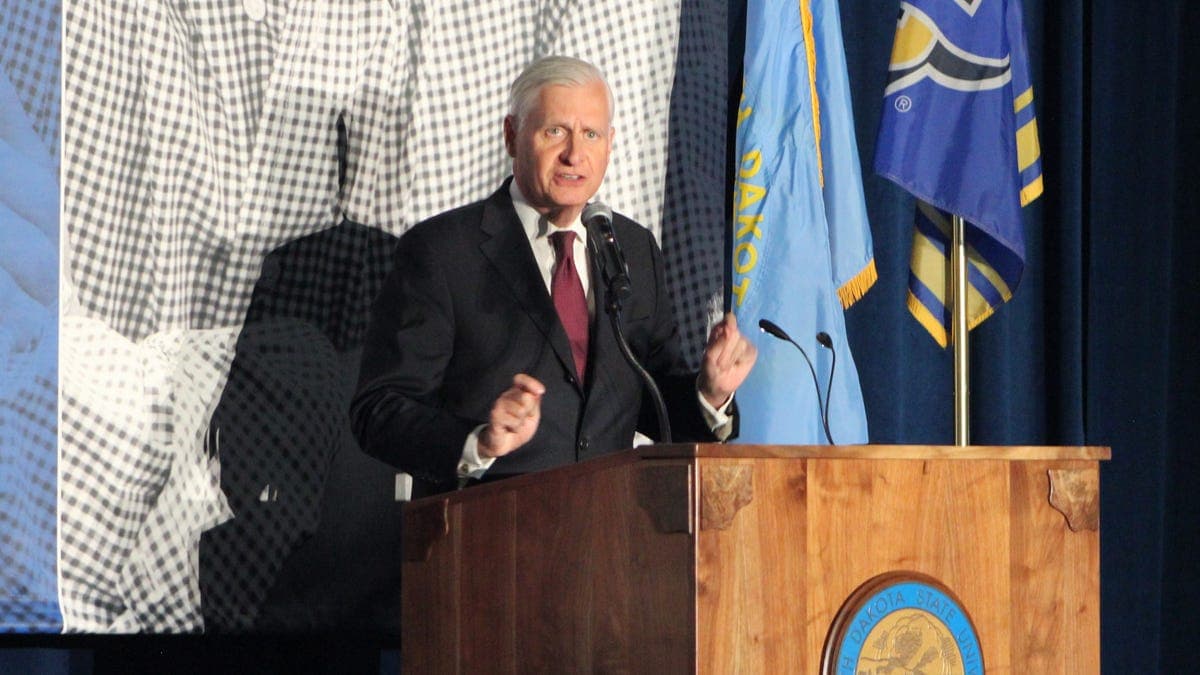
Presidential historian and Pulitzer Prize-winning author Jon Meacham spoke about President Donald Trump's place in U.S. history at South Dakota State University’s Daschle Dialogues event April 7. The talk came at a moment of uncertainty in U.S. geopolitics, beginning at 6:30 p.m. April 7, hours after Trump threatened to wipe out a “whole civilization” if Iran did not capitulate to U.S. demands, and shortly after Trump released a statement agreeing to “suspend the bombing and attack of Iran for a period of two weeks” for a double-sided ceasefire. To a crowd of several hundred people, Meacham made no mention of the Iran situation, but spoke from his expertise as a presidential historian and analyzed the Trump administration’s place in history. The event is named for Tom Daschle, a 1969 SDSU alumnus who served in Congress for 26 years, was one of the longest-serving Senate democratic leaders in history, and was one of two to serve twice as both minority and majority leader. Daschle said Meacham is one of the “greatest public intellectuals we have in our country today,” and said Meacham’s book, “America’s Struggle: Democracy, Dissent, and the Pursuit of a More Perfect Union,” would like to see it become “mandatory reading for every member of Congress,” which received laughter and applause from the audience at SDSU. Meacham said he’s not a Democrat or a Republican, but has voted for candidates from both parties. He said polarized politics are “dominated by a devoted minority.” “I’m not willing to surrender an experiment that began in Philadelphia, for which men and women have died from Lexington and Concord to Gettysburg, to Omaha Beach, to the Edmund Pettus Bridge, " Meacham said to applause from the crowd at the SDSU First Bank & Trust Arena. "I’m not willing to give that up because of the social media algorithm and cable news." He explained that patriotism is an allegiance to an idea, whereas nationalism is an allegiance to “your own kind, to people who look like you, who happen to be born where you were born.” “I, for one, decline to surrender patriotism to a nationalist impulse,” Meacham said. Meacham said he’s often asked two questions “out in the world:” one, “How did this happen?” and two, “How do we get out of it?” “One of the reasons we are where we are is that the incumbent president of the United States is a vastly entertaining figure,” Meacham said. Democratic candidates in the future need to know that they are now “putting on a 24-hour show,” he said. “Let’s not be dismissive of this. We have the capacity, if we choose to, to elevate the tone, which, by the way, is not very hard, right? The bar is pretty low to do that. And in this 250th year to say, ‘You know what, just enough of us have decided that America is not a reality show,’” Meacham said. Former USA Today reporter Chuck Raasch asked Meacham about his judgment of President Trump as a “dangerous but recognizable demagogue” in his first term, and how Jan. 6, 2021 was “tangible proof” that Trump was willing to follow through on the authoritative threats he made. “I now see him as a genuine aberration in our history — a man whose contempt for constitutional democracy makes him a unique threat to the nation,” Meacham wrote in the New York Times on Nov. 5, 2024. At SDSU, Meacham called Trump’s cabinet a “Star Wars varsity,” and said he wants every day of his presidency to be “like an episode of a reality show” in which he “vanquishes his foes,” and said that the cabinet is his supporting cast. Meacham inexplicitly, or perhaps inadvertently, referenced Trump’s “Make America Great Again” slogan several times throughout the talk, which has long been criticized for idealizing an era of fewer civil rights protections for women, people of color and LGBTQ+ and Two Spirit individuals. “I hesitate sometimes to say ‘back in balance,’ as if there were some edenic, paradisiacal moment that somehow existed before 2015, and ‘if only we could go back to that,’” Meacham said. “Going back to the past, just as it was, is fine if you look like me,” he continued. “I’m a boringly heterosexual white Southern male Episcopalian… Things work out for me in this country. The point of the country is, it’s supposed to work out for everyone who plays by the rules.” “There was not a ‘Once upon a time’ in American history, and there will not be a ‘Happily ever after,’” Meacham said. “Why? Because we are human beings. We are fallen, frail, fallible. We are shaped by sin and short time. We are torn between grace, rage, kindness, cruelty, light and dark, every hour of every day.” He also said he has acquaintances in his family who are being “caught up” in deportation. He said that if people enter the country illegally, “there has to be a good price for that,” but doesn’t think that the country “voted to take grandparents off in shackles.” “If we are, in fact, going to be judged on how we treat the least of these, it’s gonna be a rough judgement,” Meacham said. Meacham said if time were reversed, “there’s no chance I would vote for someone who has so self-evidently put themselves ahead of the country,” Meacham said. Two of five Senate majority leaders from this century came from South Dakota, and Raasch asked Meacham if that was a coincidence or if there was something more to it. Meacham asked if there was something in the water in South Dakota that makes Senate majority leaders, and asked Raasch for his thoughts. Raasch thought it might have to do with the political upbringing of people from the Republican and Democratic parties in the state; growing accustomed to working with the other side, some of which has “gone away,” Raasch said; and a kind of “Midwestern stoicism” that’s needed in the Senate, he added. Meacham said Sen. John Thune “seems like a very good man,” and said his job as Senate majority leader is much like a “radar operator at Pearl Harbor.”

South Dakota 'not the problem' in USPS delays, Dusty Johnson says
USPS to add 8% surcharge to cover transportation costs, fuel prices rise The average cost for a gallon of gas on Long Island is up 17 cents from last week and up $1.02 from this time last month, according to AAA. USPS package delivery in Sioux Falls has improved to over 90% on-time, but regional "choke points" still cause significant delays. Lawmakers identified major issues at regional hubs like St. Louis and Kansas City as the primary source of mail slowdowns affecting South Dakota. A new high-speed package sorter is expected to be installed at the Sioux Falls distribution center in June to improve local delivery. Although the United States Postal Service (USPS) mail service in Sioux Falls is now delivering packages at more than 90%, according to U.S. Rep. Dusty Johnson, regional “choke points” still pose significant issues overall. In Sioux Falls and South Dakota specifically, service has slightly improved during the last 18 months, Johnson told reporters following a private tour Thursday, April 2, at the Sioux Falls USPS Distribution and Processing Center, accompanied by Pete Sessions, Texas Representative and chair of the House subcommittee overseeing USPS. The tour comes about 3.5 months after Johnson led a roundtable discussion surrounding the mounting frustration with USPS delays, missed medications, lost checks, overflowing mailboxes and long lines at the post office. During that previous roundtable discussion, Sessions pledged immediate involvement to make sure South Dakotans’ voices are also heard. Sessions, having traveled to Sioux Falls from Texas, accompanied Johnson on the tour, hoping to “shed some light on the struggles South Dakotans have been experiencing when it comes to the Postal Service,” said Kristin Blakley, Johnson’s communications director, in an email to the Argus Leader. “For the last three or four months, Pete has been incredibly involved,” Johnson said. “His team is filled with experts. The chairman understands these problems, and in part because of his help, I think there have been three big improvements.” Johnson relayed that there are also three ongoing challenges regarding USPS operations. "South Dakota service has improved, and now packages are being delivered more than 90% of the time, on time," Johnson said. "That's not good enough, but it is materially ahead of what we have seen." Both Congressmen also concluded that USPS facilities in Sioux Falls, as well as the state of South Dakota, do not seem to be the root of what they consider “a much broader issue entirely.” “South Dakota is not the problem,” Johnson stated. “Our people are getting it done. Our facilities are getting it done.” Sessions concurred with this, noting that he sees the same spirit of “great pride” in Sioux Falls that his community in Texas also possesses. “We saw that at the postal operation center today… People who sincerely care,” Sessions stated. “I see this community as people who work together, who get things done.” Both lawmakers said the biggest problems stem from regional distribution hubs such as St. Louis and Kansas City, where staffing shortages, outdated facilities and operational backlogs continue to delay mail before it reaches South Dakota. USPS has been shifting its network toward larger regional hubs, which has caused widespread slowdowns since 2025. The agency has argued the changes are necessary to cut costs and avoid insolvency, but customers in states like South Dakota have seen some of the steepest service disruptions. Johnson said the St. Louis distribution center has added 190 employees in recent weeks, which he described as “moving in the right direction.” Still, he said the USPS has yet to produce the “multi‑year, detailed plan” required to address long‑term challenges at major Midwestern hubs, such as “necessary” facility upgrades. One major improvement Johnson relayed was a “massive” new USPS Parallel Induction Linear Sorter (PILS) at the distribution center in northern Sioux Falls, replacing a 27‑year‑old system. The machine is capable of handling 7,000 packages per hour up to 30 pounds, which would significantly reduce manual sorting. The new Sioux Falls USPS PILS is expected to be installed in June. “It's going to kind of transform delivery in South Dakota,” Johnson said. In addition to mail services being bogged down at the larger regional distribution centers, Johnson noted two other key issues with the USPS are: discontinuing mail services at all Hy-Vee and Lewis Drug stores and a lack of communication and transparency with USPS leadership. “We've been rattling this cage for more than the last year,” Johnson said. When the tour request was finally granted, Johnson expressed his frustration that the media were not allowed to accompany the tour. “They have a story to tell,” Johnson said. “We can help them tell that story, but they also need to be willing to help themselves more.” In late September 2025, USPS officials made the decision to end all USPS operations at Lewis Drug and Hy-Vee stores in Sioux Falls, Brandon, Tea and Harrisburg. The move was meant to be a better way to “fulfill our commitment to serve our communities with efficient and reliable access to retail services,” according to an emailed statement at the time from USPS Strategic Communications Specialist Tara Jarrett to the Argus Leader. Johnson referred to this change as possibly “the single biggest mistake they have made in Sioux Falls with mail service.” Johnson also reiterated this to media Thursday after the tour. “Shutting down the Hy-Vee and Lewis service counters was a massive error,” Johnson said. “I have formally asked for them [USPS] to reverse that decision.” Sessions also acknowledged that the USPS is “struggling”—much like other large organizations—to recruit workers, keep up with technology and adjust to population shifts. “The system needs to work properly,” he said, emphasizing the growing importance of reliable delivery for mail‑order prescriptions and expanding package volume. Sessions said shifting population patterns are adding pressure to the Postal Service, noting that “people are moving from larger cities to smaller cities,” which changes where customers — and employees — are located. “These changes mean that the post office needs to adapt… Not only in their operations, but also in the number of people and where they’re located,” he said. Another major driver of operational strain, Sessions said, has to do with what’s referred to as the “last mile,” - that final stretch from a post office or distribution center to someone’s home, farm, or business. Private carriers like UPS or FedEx can choose not to serve certain areas if it’s too costly. USPS is legally required to serve every address in the country, no matter how remote, rural and expensive it is to reach. As a result, private carriers have increasingly relied on USPS for final delivery due to cost savings. The USPS makes those last-mile deliveries three to five times a week, regardless of volume. The partnership brings in revenue, but also forces the USPS to shift from smaller vehicles to larger trucks and vans, Sessions said. Sessions said Johnson left the meeting with “specific data and information that will help not only the post office but him communicate” with constituents about expected service improvements. Sessions repeatedly credited Johnson for pushing for practical fixes rather than political criticism. “What can we do to help? What can we do to be not a part of the problem, but a part of the solution?” he said, describing Johnson’s approach. “There has been no issue that has emerged more emotionally and more aggressively in the last three years than complaints about the Postal Service,” Johnson said. "It is a relatively new and very hot issue, and I'm grateful that the Postal Service is making some of these investments in Sioux Falls and elsewhere in response to the complaints.” Vanessa Carlson Bender is the Development and Public Health Reporter at the Sioux Falls Argus Leader. Reach her at vbender@gannett.com.
South Dakota 'not the problem' in USPS delays, Dusty Johnson says
USPS to add 8% surcharge to cover transportation costs, fuel prices rise The average cost for a gallon of gas on Long Island is up 17 cents from last week and up $1.02 from this time last month, according to AAA. USPS package delivery in Sioux Falls has improved to over 90% on-time, but regional "choke points" still cause significant delays. Lawmakers identified major issues at regional hubs like St. Louis and Kansas City as the primary source of mail slowdowns affecting South Dakota. A new high-speed package sorter is expected to be installed at the Sioux Falls distribution center in June to improve local delivery. Although the United States Postal Service (USPS) mail service in Sioux Falls is now delivering packages at more than 90%, according to U.S. Rep. Dusty Johnson, regional “choke points” still pose significant issues overall. In Sioux Falls and South Dakota specifically, service has slightly improved during the last 18 months, Johnson told reporters following a private tour Thursday, April 2, at the Sioux Falls USPS Distribution and Processing Center, accompanied by Pete Sessions, Texas Representative and chair of the House subcommittee overseeing USPS. The tour comes about 3.5 months after Johnson led a roundtable discussion surrounding the mounting frustration with USPS delays, missed medications, lost checks, overflowing mailboxes and long lines at the post office. During that previous roundtable discussion, Sessions pledged immediate involvement to make sure South Dakotans’ voices are also heard. Sessions, having traveled to Sioux Falls from Texas, accompanied Johnson on the tour, hoping to “shed some light on the struggles South Dakotans have been experiencing when it comes to the Postal Service,” said Kristin Blakley, Johnson’s communications director, in an email to the Argus Leader. “For the last three or four months, Pete has been incredibly involved,” Johnson said. “His team is filled with experts. The chairman understands these problems, and in part because of his help, I think there have been three big improvements.” Johnson relayed that there are also three ongoing challenges regarding USPS operations. "South Dakota service has improved, and now packages are being delivered more than 90% of the time, on time," Johnson said. "That's not good enough, but it is materially ahead of what we have seen." Both Congressmen also concluded that USPS facilities in Sioux Falls, as well as the state of South Dakota, do not seem to be the root of what they consider “a much broader issue entirely.” “South Dakota is not the problem,” Johnson stated. “Our people are getting it done. Our facilities are getting it done.” Sessions concurred with this, noting that he sees the same spirit of “great pride” in Sioux Falls that his community in Texas also possesses. “We saw that at the postal operation center today… People who sincerely care,” Sessions stated. “I see this community as people who work together, who get things done.” Both lawmakers said the biggest problems stem from regional distribution hubs such as St. Louis and Kansas City, where staffing shortages, outdated facilities and operational backlogs continue to delay mail before it reaches South Dakota. USPS has been shifting its network toward larger regional hubs, which has caused widespread slowdowns since 2025. The agency has argued the changes are necessary to cut costs and avoid insolvency, but customers in states like South Dakota have seen some of the steepest service disruptions. Johnson said the St. Louis distribution center has added 190 employees in recent weeks, which he described as “moving in the right direction.” Still, he said the USPS has yet to produce the “multi‑year, detailed plan” required to address long‑term challenges at major Midwestern hubs, such as “necessary” facility upgrades. One major improvement Johnson relayed was a “massive” new USPS Parallel Induction Linear Sorter (PILS) at the distribution center in northern Sioux Falls, replacing a 27‑year‑old system. The machine is capable of handling 7,000 packages per hour up to 30 pounds, which would significantly reduce manual sorting. The new Sioux Falls USPS PILS is expected to be installed in June. “It's going to kind of transform delivery in South Dakota,” Johnson said. In addition to mail services being bogged down at the larger regional distribution centers, Johnson noted two other key issues with the USPS are: discontinuing mail services at all Hy-Vee and Lewis Drug stores and a lack of communication and transparency with USPS leadership. “We've been rattling this cage for more than the last year,” Johnson said. When the tour request was finally granted, Johnson expressed his frustration that the media were not allowed to accompany the tour. “They have a story to tell,” Johnson said. “We can help them tell that story, but they also need to be willing to help themselves more.” In late September 2025, USPS officials made the decision to end all USPS operations at Lewis Drug and Hy-Vee stores in Sioux Falls, Brandon, Tea and Harrisburg. The move was meant to be a better way to “fulfill our commitment to serve our communities with efficient and reliable access to retail services,” according to an emailed statement at the time from USPS Strategic Communications Specialist Tara Jarrett to the Argus Leader. Johnson referred to this change as possibly “the single biggest mistake they have made in Sioux Falls with mail service.” Johnson also reiterated this to media Thursday after the tour. “Shutting down the Hy-Vee and Lewis service counters was a massive error,” Johnson said. “I have formally asked for them [USPS] to reverse that decision.” Sessions also acknowledged that the USPS is “struggling”—much like other large organizations—to recruit workers, keep up with technology and adjust to population shifts. “The system needs to work properly,” he said, emphasizing the growing importance of reliable delivery for mail‑order prescriptions and expanding package volume. Sessions said shifting population patterns are adding pressure to the Postal Service, noting that “people are moving from larger cities to smaller cities,” which changes where customers — and employees — are located. “These changes mean that the post office needs to adapt… Not only in their operations, but also in the number of people and where they’re located,” he said. Another major driver of operational strain, Sessions said, has to do with what’s referred to as the “last mile,” - that final stretch from a post office or distribution center to someone’s home, farm, or business. Private carriers like UPS or FedEx can choose not to serve certain areas if it’s too costly. USPS is legally required to serve every address in the country, no matter how remote, rural and expensive it is to reach. As a result, private carriers have increasingly relied on USPS for final delivery due to cost savings. The USPS makes those last-mile deliveries three to five times a week, regardless of volume. The partnership brings in revenue, but also forces the USPS to shift from smaller vehicles to larger trucks and vans, Sessions said. Sessions said Johnson left the meeting with “specific data and information that will help not only the post office but him communicate” with constituents about expected service improvements. Sessions repeatedly credited Johnson for pushing for practical fixes rather than political criticism. “What can we do to help? What can we do to be not a part of the problem, but a part of the solution?” he said, describing Johnson’s approach. “There has been no issue that has emerged more emotionally and more aggressively in the last three years than complaints about the Postal Service,” Johnson said. "It is a relatively new and very hot issue, and I'm grateful that the Postal Service is making some of these investments in Sioux Falls and elsewhere in response to the complaints.” Vanessa Carlson Bender is the Development and Public Health Reporter at the Sioux Falls Argus Leader. Reach her at vbender@gannett.com.